
Biology students often dream of conducting real research, but the cost of equipment can put those opportunities out of reach.
At Rock Hill High School, the Moving Biology Forward Grant is closing that gap — transforming a classroom into a working laboratory and giving students hands-on research experience that feels more like a collegiate lab than a high school science room.
Students move between experiments in soil acidity, monitoring plant metabolism, and tracking the behavior of slime mold. For the first time in years, hands-on biological research is not something students only read about in a textbook. It is unfolding in real time.
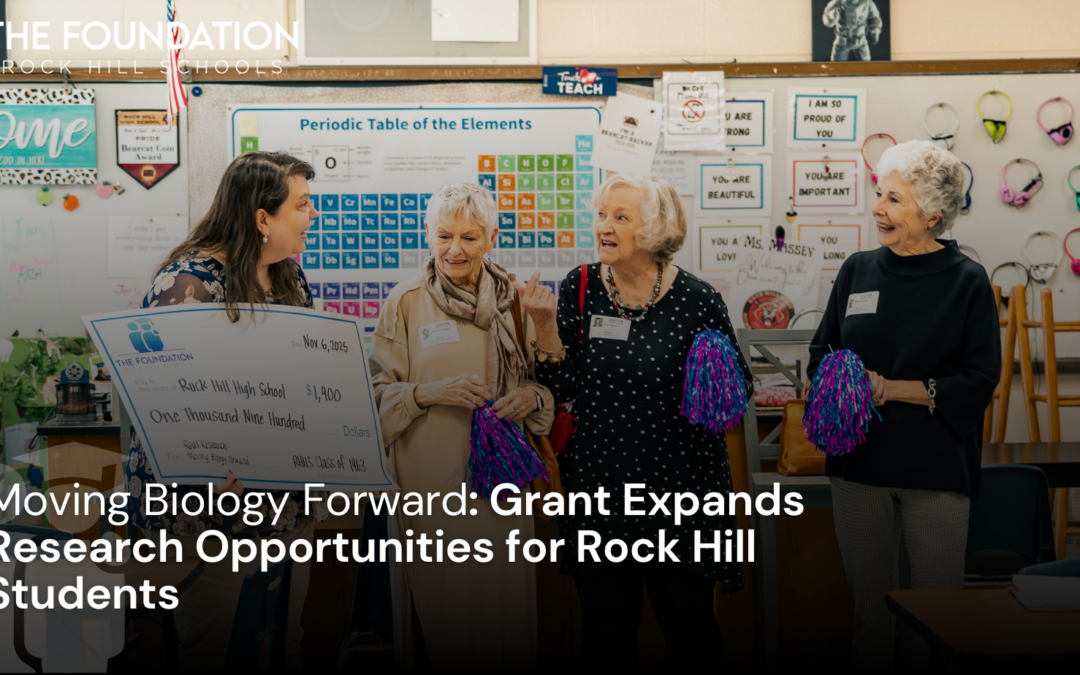
This transformation began with the Moving Biology Forward Grant, made possible through the Foundation for Rock Hill Schools’ Educator Grant program — and supported by a meaningful investment from the Rock Hill High School Class of 1963. Their generous gift to the Foundation reflects a powerful full-circle commitment: graduates investing in the education of today’s students, ensuring future generations have access to opportunities that prepare them for what lies ahead.
The Foundation for Rock Hill Schools provides more than $150,000 in annual grant funding to educators to foster innovative classroom projects and student success. The Foundation awards educator grants twice yearly to support creative and hands-on learning experiences.
Mrs. Holly Massey, who teaches AP Biology alongside other science courses, applied for the grant with a clear goal. She wanted to give her students access to the tools they need to pursue authentic scientific research.
“I have some of the most intelligent students in the district in my AP Biology class, and I want them to know that they can go anywhere and do anything,” she said. “They have the desire to start and experience research as high school students, but we just didn’t have the equipment.”
Science equipment, she explained, is expensive. Determined to remove that barrier, she wrote the grant proposal so her students could conduct the kind of experiments typically reserved for higher education laboratories.
The impact has extended well beyond her AP Biology class. Biology I students who see the advanced experiments underway are now expressing interest in pursuing research of their own. Curiosity is spreading beyond a single classroom.
“Everyone wants to know what is happening in Mrs. Massey’s room,” she said.
That momentum has taken root in unexpected ways. Students involved in the grant launched a Garden Club, bringing new life to the school greenhouse. Some participants had never planted a seed before this year. Now they are cultivating flowers, herbs, and vegetables while learning the science behind growth and sustainability.
Grants like Moving Biology Forward demonstrate what becomes possible when educators are equipped with resources beyond the basics.
“Imagine how many students would fall in love with science if they had the resources they needed,” she said.
State funding covers essential materials, but many teachers supplement their classrooms with personal funds to expand opportunities. Support from community donors, alumni like the Class of 1963, and local partners allows classrooms to move from foundational instruction to transformative learning experiences — where students are not just studying science, but becoming scientists.
Are you interested in partnering with us to continue investing in impactful projects and grants like this one? Make an investment today by clicking here.